Showing posts with label Produce Garden. Show all posts

Wednesday, 22 June 2016

Three Sisters Planted

Bed 15 with corn, squash and beans
At last, everything is in the ground. The last holdouts had been the Three Sisters that require the corn to be established ( 4 inches or so) before the squash and beans are planted around them. Each bed took two packages of beans (about 50 beans) and two packages of squash (about 50 or more). If we had too many seeds, we just went back in the same row; too few, we just spread them out more. Since each bed is 4 x 22, there is "around" "roughly" "about" one squash/bean per square foot (i.e one squash/bean seed per corn seed). We'll see later if we are undercrowded or overcrowded. 


Here's another picture:
Bed 13 with corn, beans, squash plus some potatoes from last year.

Saturday, 11 June 2016

Eggplants, we have a problem.

and there it was . . . gone
As I mentioned in my post of June 4 titled Planting Bee #1 Successful, 


Eggplant is somewhat of an anomaly in this group as it is not quite "historically accurate" regarding Riel House. Thomas Jefferson, the third president of the United States, grew and consumed this vegetable from his Monticello garden in the late 1700's. However, it was not popularized in North America as a vegetable to be consumed until the turn of the twentieth century. Also, in temperate climates such as Riel House, eggplant is typically started indoors eight to ten weeks prior to last frost and requires at least 80 days to mature before first frost. We have set ourselves a challenge.

On June 4, we had planted 16 eggplants that we had purchased once we realized how long seeds took to sprout and mature. On Monday, June 6, we planted Beds 3 and 4 with eggplant seeds that we had previously purchased.On Wednesday, we noted that several of the poorer quality eggplants had been eaten by rabbits. Friday, all the plants have been eaten.

the challenge is over. For this location, eggplants are not historical, require too much care to get started, take too long to mature  and are a delicacy to the local pest. We give up! 

Friday afternoon, we purchased more Red Pontiac potatoes.


Saturday, 31 October 2015

More Leaves

The last yard waste pickup of the year missed my neighbour's house around the corner. Twenty-three bags of great leaves. What a great opportunity to top off each of the beds to which we had just added fifteen yards of aged cow manure. The leaves will help to minimize erosion in the beds this fall and next spring; and once we get to spring, the worms will take over and incorporate everything into the soil. What a great find!

Here's what the entire garden looked like after we were finished and you can see how the individual beds have changed since we started photographing each bed last April. 

Wednesday, 21 October 2015

End of Season 2015

Today we finished at Riel House by transferring the last of the mulch pile in the parking lot into the Parking Lot Garden.
At last! 21 October 2015
It has been a strenuous year. Perhaps we took on too much this year by planting a two thousand square foot Parking Lot Garden with native plants and creating thirty raised beds in the Produce Garden, each bed four feet wide and twenty-two feet long. But it's done, and everything looks great. 

To see what our thirty raised beds look like, here's the Produce Garden 2015 video.


Friday, 2 October 2015

Leaves

My neighbour's property is a leaf magnet. Although the surrounding houses have some leaves this time of the year, their house would be knee deep in leaves were they not diligent in raking and bagging them.

Fortunately leaves are great mulch: helping soil retain moisture, preventing erosion, suffocating weeds and minimizing soil compaction where we walk. If we incorporate leaves in beds, particularly shredded leaves, that helps to enrich the soil. Last year we added 100 bags of leaves into the paths and beds.

This morning, I took my neighbour's first seven bags of the year to Riel House and distributed them along the central path in the Produce Garden. Last year's mulch had disintegrated over the summer.

First seven bags - October 2015

About 2/3 of the central path covered - 2015

Thursday, 1 October 2015

Ain't No Mountain High Enough: Moving Manure Part 2


When you put a former IT manager and an accountant/educator together, everything immediately turns into process. How can activities be effective and efficient? How do you employ the correct resources at the right time? How do you stop from running into each other?

So even though this is gardening, here's what we've learned about process after just one morning of manure work:
  • two people are required at a minimum.
  • recognize that fifteen yards of manure must be dumped outside of a fenced in garden with raised beds. In our case, the distance to be traveled from pile to bed and back is up to 200 feet.
  • ask for aged manure that has been sieved. Since ours wasn't sieved, separate the big lumps as you are loading the good manure to be moved. The big lumps go in a storage area that already contains almost-ready soil, compost and leaves.
  • transport the good manure in four 21L pails(.75 cubic feet) inside a wheel barrow (6 cubic feet) since it is too hard to unload this size of wheelbarrow in the constrained space between rows and up in raised beds
  • each person loads two pails all the while separating the big lumps.
  • the first person takes the manure into the beds and dumps the individual pails then exits the garden and returns to the pile. Once each bed is full (currently sixteen pails), rake the manure over the entire bed.
  • the second person keeps the source pile neat, rakes the manure on either side of the loading area all the while looking for more large lumps for the storage area. 
  • We anticipate it takes half an hour to top off each of our beds with the manure.
  • If there are more than two people, the third person rakes the raised beds.
  • If there are more than three people, then the fourth person helps at the pile, either moving big lumps to the storage area, or keeping the pile organized. If you have another four pails, then these could be loaded for the returning first person and wheelbarrow.
  • If there are more than four people, more wheelbarrows! More pails!

Moving Manure

Today, we started to move the manure into the Produce Garden beds.The rake in the first picture defines the original perimeter of the pile. We moved about 1 1/2 yards of the 15 yards.Hmmmm 10%. We have a ways to go.

Here's the pile when we finished today:


Here's the pile when we started:


Wednesday, 30 September 2015

Manure, Glorious Manure!

If worms could sing, it would be "Food, Glorious Food!" from Oliver. But I digress.

Here's what fifteen yards of aged cow manure looks like:


You can see Produce Garden Beds 1-16 in the background are eagerly awaiting this feast.

We will place the manure on top of the beds, add shredded leaves on top of that, then water. The worms inside the beds will surface through these two new layers, grab something to eat, and then dive back down to consume and poop what they have just retrieved. Like dolphins. And that's how we make better soil!

After this first load, we'll order another fifteen yards to go into Beds 17-28 plus the Kitchen Garden. If we've underestimated, then a third load is required. 

Oh, we'll also add unshredded leaves into the paths to protect where we walk, and to help soak up rainwater that will slowly percolate under the raised beds - and keep the beds moist from underneath.

Soil Sampling in the Produce Garden.

Trying to get the soil sampler into a bed that hasn't been raised.

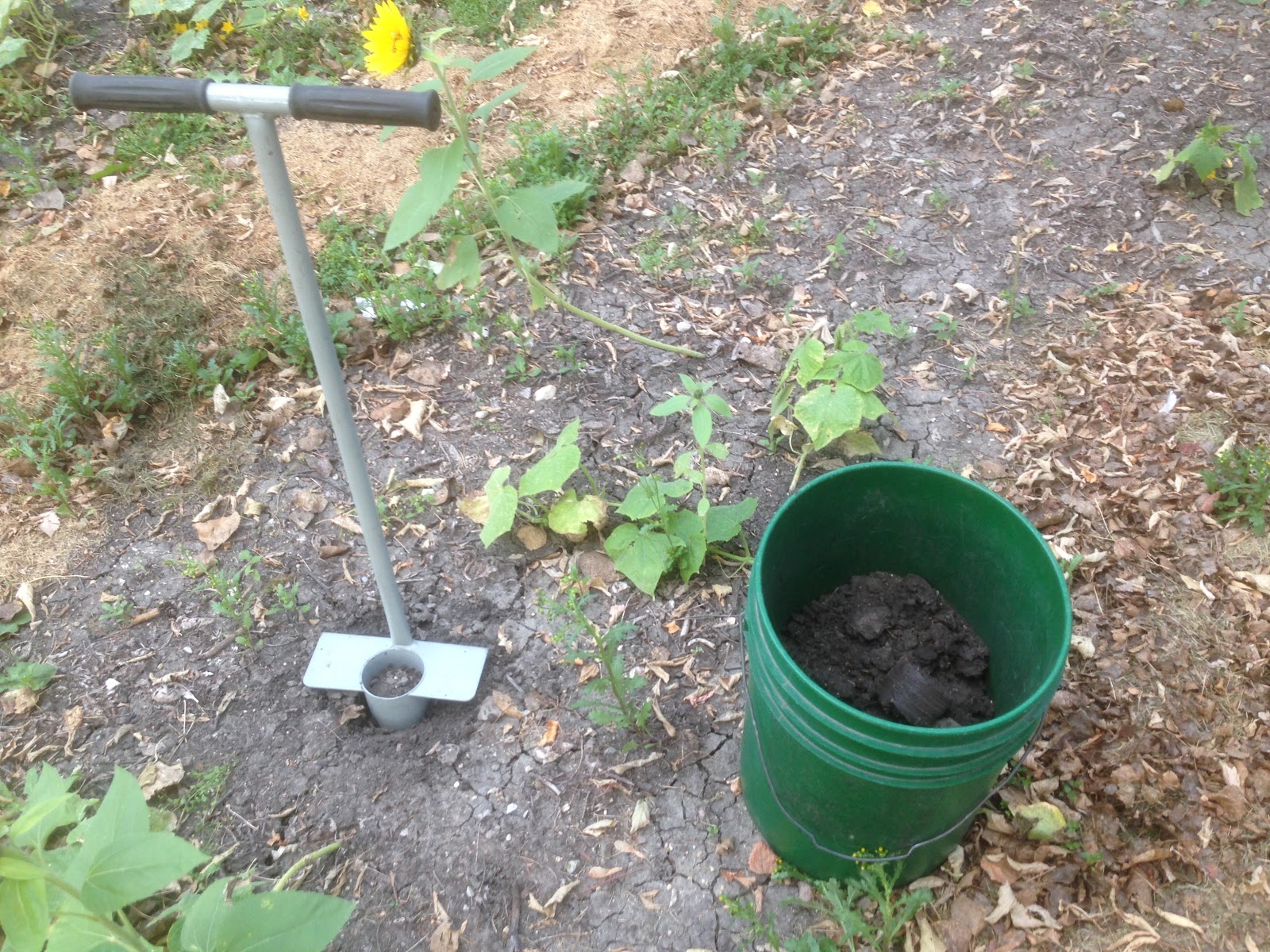
Today, we took fourteen soil samples (Beds 1 4 5 8 9 12 13 16 17 20 21 24 25 28) from the Produce Garden. We needed to do this before we started to spread manure on all the beds later this week. 

It was a "reasonable" effort to drive the soil sampler into Beds 1-8, which were the raised corn beds this year. Beds 9-16, the raised potato beds, were easy to retrieve the soil sample. The ease with which to get the samples from Beds 17-28 depended on whether we had raised the beds since the harvest of September 16. The recently raised beds were similar in effort to the corn beds. The beds that have not yet been raised proved difficult to insert the sampler. I was concerned with either breaking the horizontal plate or the vertical shaft as I levered the sampler into the ground.

When we attempted to take samples last spring (before we began raising the beds), it was very difficult to insert the sampler into the soil. Then it was almost impossible to get the sampler out of the ground. Then we couldn't get the sample out of the sampler. We gave up. Going forward, we'll take samples in the fall, and then compare them to previous years to see how we're doing.

Now we mix up the 14 samples to achieve a consistent soil mix, then select two pounds (the size of a freezer bag). That's what gets submitted to the lab for soil testing.

I'll report back once we have results.

Thursday, 24 September 2015

Digging of Remainder of Beds


We will raise the remaining beds in the Produce Garden. We started last spring (actually April 29) to dig out the paths surrounding each bed by lowering the path - and so raising the bed. Each bed takes approximately 1 1/2 hours to move soil from the path into the bed, and then place mulch in the lowered path.

Beds 17, 19 and 20 raised and paths mulched
We still have Beds 18, 21, 22, 23, 24, 25, 26, 27 and 28 to prepare. We may leave Beds 18, 26 and 28 until next spring because they contain sunflowers with their seeds that we would like to employ to attract birds (and their fertilizing poop!) over the winter. Regardless, that is nine beds at 1.5 hours per bed equals almost five volunteer days (three hours per day).

As in the previous post Leaf Mulch, Soil, Future Mulch, we are using Beds 29 and 30 as a storage area.

Wednesday, 5 August 2015

Growing, growing . . .

At last, we are staring to see some results in the garden:
Cucumber - 4 August 2015
 I do not recall in prior years if any of our cucumber plants ever bore fruit.
Tomato in the Kitchen Garden - 4 August 2015
 
Tassels on Bloody Butcher - 4 August 2015

 At last! and the plants are between ten and eleven feet high right now.
 

Friday, 31 July 2015

Leaf Mulch, Soil, Future Mulch

At last, we have moved the remaining soil and sod from the Parking Lot Garden into Beds 29-30. It was a lot of work, but much better than Parks Canada just taking away that good material and dumping it somewhere. Now we have soil that we can use to mound potatoes next year along with sod that we can water, turn and slowly make into more soil and mulch for subsequent years. Left to right, leaf mulch from last year, soil for next year, sod starting to break down:
Leaf Mulch, Soil, Future Mulch

Here is the pile on the first day after we had moved about a third of it into Bed 29. You can see last year's leaves at the back in Bed 30:
Sod Pile on 6 June 2015


Wednesday, 29 July 2015

Nine feet high and rising

The Bloody Butcher corn in Bed 1 is now over nine feet tall. The warm weather and lots of rain are certainly contributing. If only it would produce tassels and cobs as does the Mandan Bride in Bed 3.

Here is the first Mandan Bride cob:
 

Saturday, 18 July 2015

Borage

Found this growing in several of the paths in the Produce Garden:
After asking around, we've discovered (thanks Kelly!) it's borage which I know is a beneficial plant and assists in the overall health of a garden. See http://permaculturenews.org/2011/01/21/all-about-borage/ for further information.

Friday, 17 July 2015

Caragana? .. . Not any more.


There are many areas of Riel House with old unmaintained caragana. Caragana (actually the Siberian pea shrub) was introduced in the late 1880's by the federal government to be a shelter belt plant. It is likely that the Riel family added it to the property between 1900 and 1920, probably as a decorative hedge. Consequently, caragana is "not quite" appropriate to Riel House of 1886.
Before
This overgrown caragana is at the entrance to the Produce Garden. Most of the trunks that you see are quite old and only have leaves at the very end of each stem. If you look closely on the bottom right, you can see some virginia creeper trying to get to the fence. We decided it was time to put this clump out of its misery.

Thursday, 16 July 2015

Dragonflies, Hawks, Rabbits

We're starting to see more wildlife around the Produce Garden; several dragonflies including this one right next to the compost bin.

There was a hawk/kestrel chasing birds on Monday. Now if only he would also chase the rabbits. Our fox has not returned. We set a live trap Tuesday evening, but no rabbits by Wednesday morning even though the carrot that was just inside the trap had been carefully removed. The plan is to set the trap on the evening just before we volunteer the next morning. 

The rabbits definitely know how to jump an 18-inch wire fence to get into and out of the garden. Cabbage, cauliflowers and sunflowers have definitely been sampled. Also beans in the Kitchen Garden. If we set the trap in the gardens, then we only trap the smart ones - am I just being naive?

Monday, 13 July 2015

Three Sisters in the Produce Garden


At last, the squash and beans are starting to grow among the Bloody Butcher Corn in Produce Garden Bed 1. These are the Three Sisters of native Americans - both North and South America:

Plant the corn first. When the corn is six inches high, plant the beans and squash.The beans climb up the corn in order to get to the sun. Also, the beans fix nitrogen in the soil for the benefit of both corn and squash. The squash covers the ground keeping the roots of the corn and beans cool and moist. What an amazing team.

FYI below are the roots of the Bloody Butcher Corn in the same bed:

Monday, 6 July 2015

Mangels and turnips and beets, oh my.

Well, let's start with turnips. Bed 25 only. This is certainly a crop from 1886, but we are really unsure as to how it would have been planted. The seeds are extremely small and hard to manage.We will definitely have to thin. We'll see about next year.

Beets are okay, but they are also a smaller seed to plant. They are in Beds 23-24. 

Mangels. Let's talk about mangels. It's a beet relation used as animal fodder. I never heard of it until I wrote the Orientation Guide this spring. There was a visitor from Austria earlier this year that was familiar with the mangel but most North American folks don't seem to know about it. For more about mangels, see http://www.feedipedia.org/node/534
(thanks Judy)
I'm guessing the above is a mangel. I weeded it and several more from Bed 17 - until I realized that many of these weeds were growing in very regular patterns. Hmmmm - what a coincidence. The 2015 Produce Garden list dated July 5 currently shows that we planted mangels in Beds 21-22. Hmmmm - I think not. A new version of the list will be issued shortly.

I anticipate that next year we will plant over a much shorter time period and keep better tabs on where everything goes.

The Produce Garden is planted. Finally.

Turnips in Bed 25.
Mirella cucumber and sunflowers in Bed 26.
Diva and English Long Telegraph cucumbers in Beds 27-28.

Also finished up the Three Sisters planting.
Spaghetti squash in Bed 3 and Bed 8.
Table Queen squash in Bed 4 and Bed 7.

And finally, I threw some dill seeds in all the corn beds.

We will still make harvest, but having this all planted by mid-June would have been much better.

Friday, 3 July 2015

More Planting in Produce Garden

Trying to get the rest of our seeds planted now that we are finally through the Parking Lot Garden that took all of June.

We planted Scarlett Runner Beans in Beds 5-6.
We planted Beets in Beds 23-24.

We just have Beds 25-26 (turnips) and Beds 27-28 (cucumbers and sunflowers) to plant from scratch.
And we need to add some more squash into the corn beds to complete the Three Sisters.